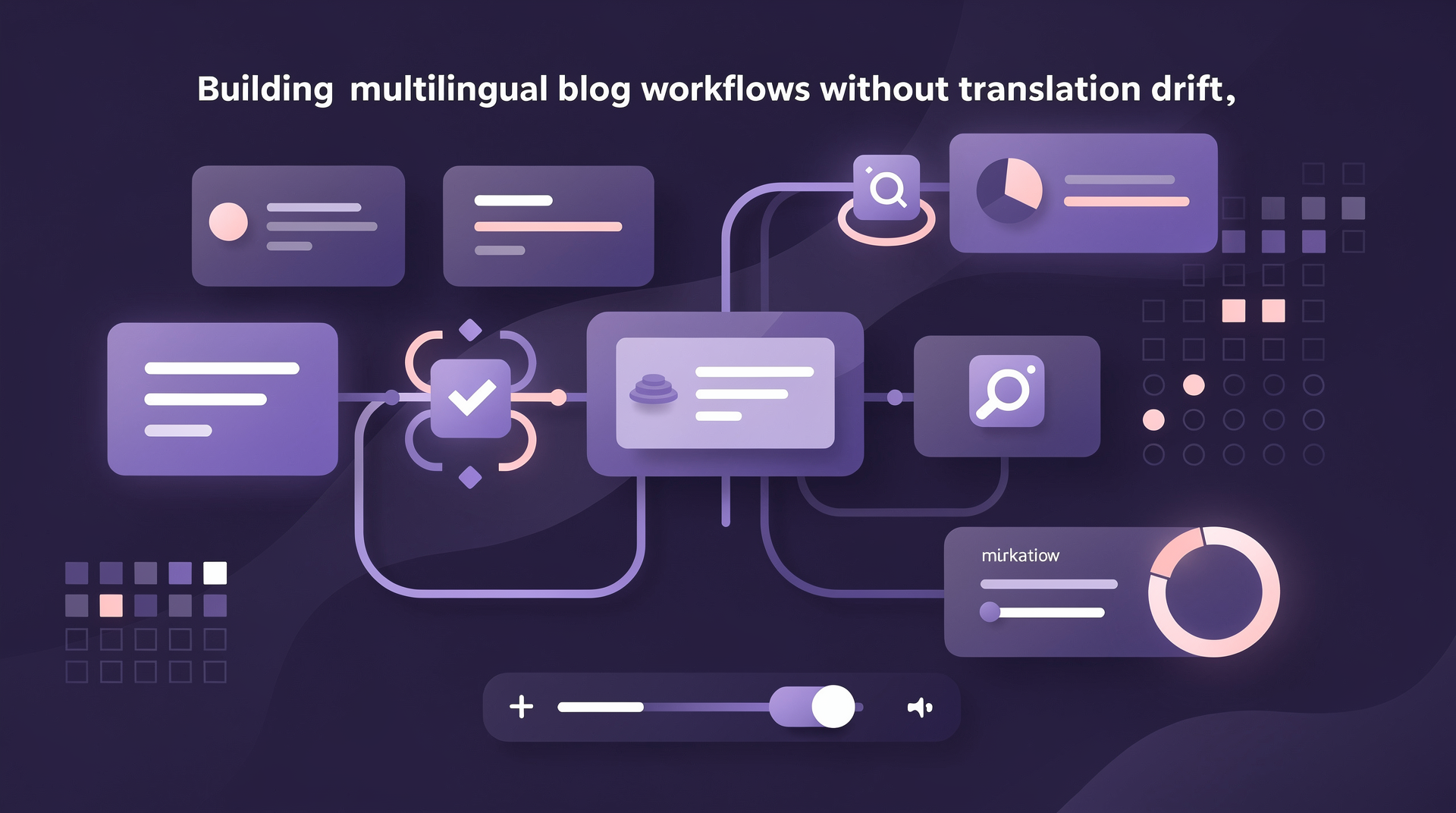
Multilingual publishing fails not because of poor translation, but because of silent, untracked evolution. Translation drift occurs when the source content shifts, terminology evolves, or language versions diverge without a synchronized update path. A robust workflow prevents this by establishing a rigid source of truth, enforcing terminology locks, and defining clear boundaries for local adaptation. The most effective systems prioritize version control and explicit review checkpoints over mere automation, ensuring that every language version remains a faithful reflection of the brand’s intent. This guide outlines the structural decisions required to keep global content aligned without forcing your team into a cycle of constant manual rewrites, helping you move from reactive patching to proactive synchronization.
Start with a single source of truth
Drift is inevitable when language teams operate from fragmented drafts. A single source of truth requires one canonical master document that serves as the definitive reference for every translation. The critical failure point here is versioning: if your English content moves from v1.2 to v1.3, every translation team must know exactly which revision they are working from. A common, hidden risk is that "minor" source edits—such as updating a CTA or refining a product benefit—often carry more weight than the original text. For example, changing “monthly reporting” to “weekly reporting” can invalidate an entire paragraph that references a monthly cadence later in the article. In practice, you should implement a "delta-tracking" system where any change to the source triggers a notification to all regional leads, highlighting exactly which paragraphs were modified. If a change affects the structure, promise, or technical accuracy of the content, treat it as a new revision and trigger a mandatory review across all active languages. Without this, you end up with "ghost" versions where the English site promises a feature that the French or German versions have yet to acknowledge, leading to immediate customer confusion and a loss of brand authority.
Lock terminology before translation starts
Terminology drift is the silent killer of brand consistency. When product names, feature labels, or technical categories are translated inconsistently, the user experience fragments. A terminology glossary is your primary defense, but it must include usage context, not just direct translations. For instance, the term “workflow” might require different translations depending on whether it appears in a marketing context or a technical operations manual. A micro-example of this failure: if one article refers to an “editorial calendar” and another uses “content schedule,” your readers will assume you are describing two different systems. To prevent this, your glossary must be integrated directly into your CMS or translation management system (TMS) so that translators receive real-time alerts when they deviate from approved terms. The decision rule is to lock high-frequency terms in a centralized glossary and mandate a review whenever a new, recurring phrase appears in the source. If a term isn’t in the glossary, it shouldn’t be translated until a lead editor approves the equivalent. This prevents the "creative translation" trap where local teams invent their own terminology, which inevitably leads to a disjointed user journey across your global web presence.
Separate what must stay consistent from what can adapt
Not every element of a blog post requires the same level of rigidity. Headings, product claims, legal disclaimers, and UI screenshots demand strict adherence to the source, while cultural references or regional examples often benefit from local adaptation. The expert move is to classify content by sensitivity: fixed, guided, or flexible. Fixed content must match across all languages; guided content allows for stylistic adjustments that maintain the original intent; flexible content permits regional metaphors or examples. The hidden risk is over-localizing a sentence that carries core brand value; a "clever" rewrite in a local market can inadvertently soften a value proposition or change the reader’s takeaway. For instance, a US-based metaphor about "hitting a home run" might be completely lost in a European market, but the underlying message of "achieving a high-impact result" must remain intact. The decision rule is to tag each section by sensitivity level before translation begins, ensuring reviewers know exactly where they have the authority to adapt and where they must remain literal. By creating a "content map" that identifies these zones, you empower local teams to be relevant without sacrificing the core message that keeps your brand identity unified globally.
Build review steps that catch divergence early
Quality review is often treated as a final, post-formatting step, which is too late to catch structural drift. Instead, implement a tiered review process: source review, translation review, and a side-by-side comparison before the post goes live. The most effective check is a "divergence audit" that occurs at the draft stage, where a bilingual editor compares the source and the target side-by-side to ensure that the logical flow hasn't been broken by an over-eager translator. A common failure mode is the "translation-of-a-translation" effect, where a regional team translates from a previous, outdated translation rather than the canonical source. To mitigate this, enforce a rule where all translations must be linked to a specific source ID in your database. If the source ID doesn't match the current version, the translation is automatically flagged for re-review. This audit should specifically look for "semantic drift"—where the words are technically correct, but the tone or the urgency of the original English has been lost. By catching these discrepancies before the content is pushed to the live site, you avoid the costly and embarrassing process of having to pull down and re-publish content that has already been indexed by search engines.
Automate the synchronization of metadata and SEO
Metadata is the most frequently overlooked area of multilingual drift. If your English meta-description is updated to reflect a new seasonal offer, but your Spanish or Japanese meta-tags remain on the old version, you are effectively misrepresenting your site to search engines. This leads to a "click-through mismatch" where the search result promises one thing, but the landing page delivers another. To prevent this, treat your SEO metadata as a first-class citizen in your translation workflow. Every time you update a title tag or meta-description, the system should automatically generate a "translation request" for all active locales. Furthermore, ensure that your URL slugs are handled with a consistent transliteration strategy. If you use a translated slug in one language but a transliterated one in another, you create a fragmented URL structure that is difficult to track in analytics. The decision rule is to treat metadata as a "fixed" content type that requires an immediate, automated sync across all versions. By automating the propagation of these small but critical text blocks, you ensure that your global SEO strategy remains as cohesive as your primary site, preventing the common issue of "orphan" pages that rank for outdated or irrelevant keywords.
Conclusion
Preventing translation drift is not about eliminating local nuance; it is about creating a structural framework that allows for adaptation while protecting the core integrity of your brand. By establishing a single source of truth, locking your terminology, classifying content sensitivity, implementing tiered reviews, and automating metadata synchronization, you transform your multilingual publishing from a chaotic, manual burden into a scalable, reliable asset. The goal is to build a system where the "English-first" bias is removed, and every language version is treated as a high-value, synchronized component of your global strategy. When you stop treating translation as an afterthought and start treating it as a core architectural requirement, you stop fighting drift and start building a truly global brand. Remember, the most successful multilingual blogs are those that feel native to every reader, not because they are identical, but because they are perfectly aligned in intent, tone, and accuracy.